



Olivia Plender: Little Fennel’s Complaint
Modern Art Oxford presents Little Fennel’s Complaint, a major solo exhibition by Olivia Plender (b. 1977, London), exploring historic and ongoing inequalities in women’s healthcare – from early modern witchcraft to contemporary debates on reproductive rights and medical authority.
Plender developed the exhibition through research with leading Oxford institutions, including the Bodleian Library, Oxford Botanic Garden and John Radcliffe Hospital. Across embroidered textiles, watercolours, drawings, mobiles, and sound works, she examines how women’s healthcare has been recorded, classified, and practised over time.
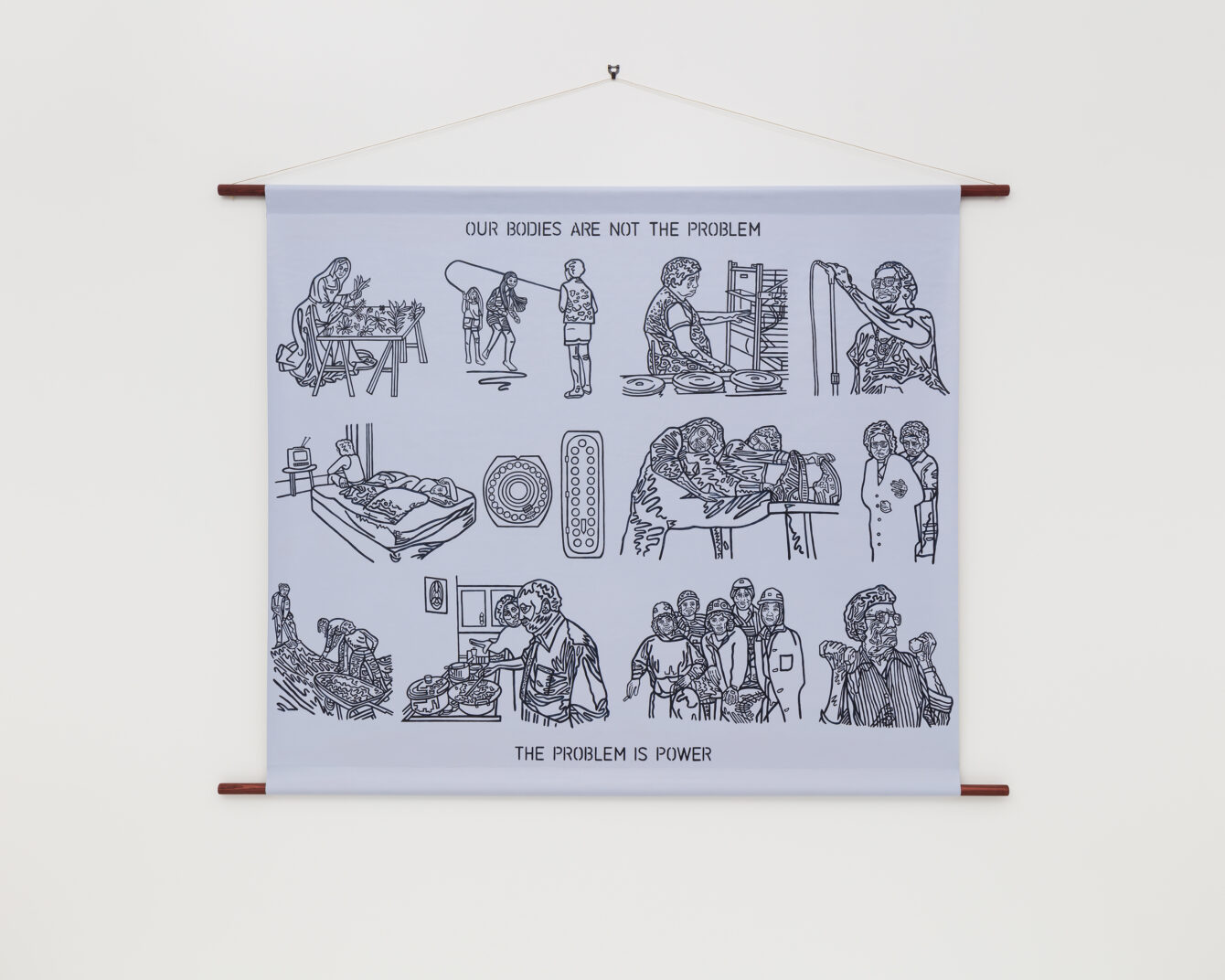
The exhibition combines new commissions, existing works, and historic manuscripts to highlight Plender’s multidisciplinary, research-led practice. Installations trace shifting approaches to medicine and diagnosis, opening with a presentation inspired by contemporary hospital architectures and waiting rooms. This builds on Plender’s ongoing project Our Bodies are Not the Problem (2021–), developed with the Glasgow Women’s Library, exploring the links between ill health, disability and structural inequalities.
Historical perspectives include Plender’s series Bringing Down the Flowers (2023–), watercolours in the style of genteel 19th-century flower paintings of plants historically used to induce abortion, referencing orally transmitted reproductive knowledge. Three 17th-century manuscripts by astrologer-physician Richard Napier, on loan from the Bodleian Library, document consultations with women about their reproductive health, alongside other ‘women’s problems’ such as ‘green sickness’, a diagnosis formerly given only to unmarried women.
Displayed alongside these is Plender’s hanging mobile (2024) reflecting on humoral medicine (based on the ancient theory of the humours) and other systems of classification from the Renaissance to today.
The exhibition culminates in a large-scale embroidered textile loosely based on scenes from the Malleus Maleficarum, a notorious treatise on witchcraft written by Heinrich Kramer (1486), which portrayed women – particularly midwives and healers – as susceptible to demonic influence.
By placing historic manuscripts alongside contemporary artworks, the exhibition asks who has the authority to define what is rational, legitimate, and true, and explores how systems of knowledge shape lived experience while opening possibilities for alternative understandings.
Olivia Plender: Little Fennel’s Complaint runs from 23 May until 16 August 2026 in Upper Galleries 2 and 3 at Modern Art Oxford.
A solo exhibition by Kira Freije: Unspeak the Chorus will also be on view in Upper Gallery 1.
Olivia Plender’s artist book titled, Our Bodies Are Not the Problem: An Adult Colouring Book will be published by Book Works, London, in December 2026.
ENDS
For media enquiries contact:
Rob Power, [email protected]
Alison Wright PR, [email protected]
About Olivia Plender
Olivia Plender (born 1977, London) is an artist based in Stockholm and London. Her work often starts with research into social movements and their histories, and she is interested in the relationships between gender, power and knowledge. Recently she has collaborated with grassroots women’s organisations on a project about the East London Federation of the Suffragettes, who aimed to establish a model for a new socialist feminist society in one of the poorest areas of the UK. Plender is currently working with Glasgow Women’s Library, Scotland, on an ongoing project Our Bodies are Not the Problem, about feminist health activism.
Plender works in a range of mediums including: installation, drawing, painting, sound, video and textiles.
Recent Exhibitions include: Sharjah Biennial 16, UAE (2025); Gothenburg Biennial, Sweden (2025 & 2017); The School of Creators, Centre Pompidou-Metz, France (2022); 59th October Salon, Belgrade (2022); Amant Foundation, New York (2022); 34th Bienal de São Paulo (2021); Taipei Biennial (2010); Manifesta 8, Murcea (2010); Altermodern: Tate Triennial, Tate Britain, London (2009). Plender is represented by Maureen Paley, London and her artworks are in various museum collections including Tate. Plender holds a PhD from Lund University, Sweden in 2024 and is currently Artist Research Fellow at the Centre for Biomedicine Self and Society at Edinburgh University. In 2024 Plender co-curated the exhibition Chronos: health, access and intimacy at Tensta Konsthall, Stockholm, combining feminist and crip perspectives.
The exhibition title Little Fennel’s Complaint draws on the Rapunzel fairy tale, in which the heroine was originally known as “little fennel” or “little parsley,” before later becoming Rapunzel (named after the herb rampion, more common in Europe).
Fennel and parsley have historically been used as abortion plants, casting the fairytale in a new light and reframing Rapunzel’s story as one about women’s bodily autonomy, agency, and control – rather than the familiar narrative of imprisonment and rescue by a prince.
‘Complaint’ is a word play on complaining/ medical complaints. It references a historic and continued pattern of women’s health issues being dismissed as ‘complaining’ and not listened to or taken seriously.
About Modern Art Oxford
Located in one of the world’s great cities of learning, Modern Art Oxford is a leading contemporary art space with an international reputation for innovative and ambitious programming. We promote creativity in all its visual forms as an agent of social change. Our programmes, both in person and online, are shaped by a belief in dialogue between contemporary art and ideas and celebrate the relevance of contemporary visual culture to society today.
modernartoxford.org.uk | Instagram | Facebook | TikTok Modern Art Oxford, 30 Pembroke Street, Oxford, UK, OX1 1BP [email protected] 01865 722 733
Modern Art Oxford is supported by Arts Council England, Oxford City Council and Lavazza.


